
Quick answer: To solve a nonogram, first fill any row or column whose clues plus gaps add up to the line length. Then use the overlap trick on the biggest clues, mark squares that must stay empty with an X, and keep switching between rows and columns. A well-made nonogram never needs guessing. The hidden picture appears when every clue is met.
By Ashish Sharma · Updated October 28, 2026 · How we tested: we worked through every rule below by hand and checked the controls (left-click fill, right-click X, drag to fill a run, tap modes on mobile) against our Nonogram Master game page. The overlap numbers in the table are simple arithmetic you can check yourself.
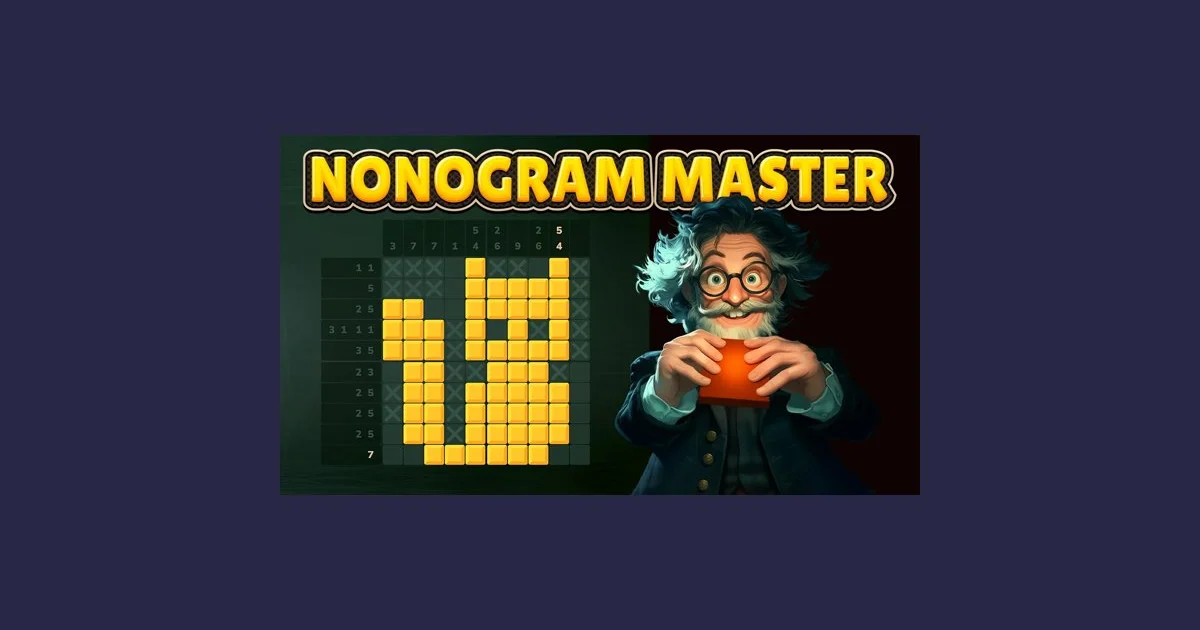
A nonogram looks like a blank grid with numbers around the edges, and the first one can feel impossible. It isn’t. Every square can be worked out with a few simple rules, and once you know them you’ll never need to guess. This guide explains how to play a nonogram and solve it step by step, with the exact tricks that crack most puzzles. Open Nonogram Master free on Gipcus in another tab and try each step as you read.
How do nonograms work?
Numbers beside each row and column give the runs of filled squares in that line, in order, with at least one gap between runs.
- Each number next to a row (or above a column) is a block of filled squares in that line.
- Several numbers mean several blocks, in that order, with at least one empty square between them. A clue of “3 1” means three filled squares, a gap, then one filled square.
- A clue of “0”, or no clue at all, means the whole line stays empty.
- When every row and column matches its clues, the filled squares reveal a hidden pixel picture.
Nonograms also go by Picross, Griddlers, Hanjie and Japanese crosswords. The rules are the same everywhere.
Step 1: Which lines can you fill straight away?
Any line where the clues plus the gaps between them equal the line length.
Add up the clue numbers, then add one for every gap between blocks. If the total equals the line length, there is only one way to place them. In a 10-square row, the clue “3 3 2” needs 3 + 3 + 2 = 8 squares plus 2 gaps, which is exactly 10, so you can fill the whole row at once. A single clue that equals the line length, like “10” in a 10-wide grid, works the same way.
Step 2: What is the overlap trick?
Slide a block fully left, then fully right. Any squares it covers both times must be filled.
This is the most useful rule in nonograms. Imagine a block pushed as far left as it can go, then as far right. Any squares it covers in both positions must be filled. In a 10-square row with the clue “7”, the block covers squares 1 to 7 on the left and 4 to 10 on the right, so squares 4, 5, 6 and 7 are certain. A quick shortcut: the number of sure squares is the clue minus the empty space left over (7 minus 3 is 4).
The trick works for rows with several clues too. Slide all the blocks to one end, then the other, and keep only the squares where the same block overlaps itself.
Overlap cheat sheet for a 10-square line
With a single clue in a 10-square line, sure squares = clue − (10 − clue). The block always covers the middle squares shown here:
| Clue | Sure filled squares | Which squares |
|---|---|---|
| 5 or less | 0 | None yet; wait for crossing clues |
| 6 | 2 | 5–6 |
| 7 | 4 | 4–7 |
| 8 | 6 | 3–8 |
| 9 | 8 | 2–9 |
| 10 | 10 | The whole line |
Step 3: When should you mark a square with an X?
As soon as a line’s clues are met, and for any square no block can reach.
Beginners usually ignore this, and it’s why they get stuck. As soon as a row’s clues are satisfied, X out every remaining square in that row. Do the same for squares a block can’t possibly reach. In Nonogram Master you right-click to place an X on PC, or switch to X mode on a phone. Those empty marks are what unlock the next row or column.
Step 4: Why work from the edges?
A filled square on the border must start or end a block, which fixes that block in place.
A filled square on the border of the grid has to be the start (or end) of a block. If the first clue in that row is “4” and square 1 is filled, squares 1 to 4 are filled and square 5 is empty. Edges pin blocks in place faster than anything in the middle.
Step 5: How do you keep making progress?
After each change, recheck every line that crosses it.
Each new square you fill or X out is a fresh clue for the line crossing it. After finishing a row, check every column it touches. Solving a nonogram is just this loop: apply the rules to one line, then hop to the lines that changed.
What are the Nonogram Master controls?
Practise these rules in Nonogram Master on Gipcus. The controls are simple:
| Action | PC | Phone or tablet |
|---|---|---|
| Fill a square | Left-click | Choose fill mode, then tap the cell |
| Mark a square with an X | Right-click | Choose X mode, then tap the cell |
| Fill or mark a whole run | Click (or press) and drag along the line | |
Drag-filling is the biggest time saver: once the overlap trick tells you a run of four is certain, drag across it in one move instead of clicking each cell.
What are the most common nonogram mistakes?
Guessing, skipping X marks, mixing up clue order, and starting with small clues.
- Guessing. A well-made nonogram never needs it. If you’re stuck, there is a line you haven’t fully checked yet.
- Skipping the X marks. Without them, you lose track of which squares are already ruled out.
- Mixing up block order. “2 5” and “5 2” are different lines. The numbers read left to right, and top to bottom for columns.
- Starting with small clues. A “1” tells you almost nothing early on. Begin with the largest numbers.
Are nonograms good for a short break?
Yes. A small grid takes a few minutes, needs no sound, and you can pause anytime, which makes it one of the best quiet puzzles for a work break. See our full list of quiet browser games for a work break and 5-minute games for a lunch break.
What logic puzzles should you try after nonograms?
- Classic Minesweeper uses the same number-clue deduction, only you’re avoiding mines instead of drawing a picture.
- Water Color Sort is a calmer sorting puzzle when you want a lighter brain workout.
- 2048 is a quick merge puzzle. Read our 2048 corner strategy guide before you start.
- Brain Test swaps strict logic for tricky riddles that reward thinking sideways. Stuck on one? See our Brain Test answers for all levels.
- Stick Merge turns merging into a battle game. See our Stick Merge guide and the merge games explainer.
Short on time? Our quiet browser games for a work break and 5-minute lunch-break games lists have more low-key picks.
Curious about other puzzle styles? Our explainer on mahjong solitaire vs match-3 breaks down another genre people often mix up.
Nonogram FAQ
How do you play a nonogram? Each number beside a row or above a column is a run of filled squares in that line, in order, with at least one empty square between runs. Fill the squares that must be filled, mark squares that must stay empty with an X, and the hidden picture appears when every clue is met.
How do you do a nonogram? Fill the lines that solve themselves first, use the overlap trick on the biggest clues, X out squares that must stay empty, then switch between rows and columns until the hidden picture appears.
Do you ever have to guess in a nonogram? No. A properly designed nonogram has one solution you can reach with logic alone.
What is the best way to start a nonogram? Look for lines that solve themselves, then use the overlap trick on the biggest clues.
What’s the difference between a nonogram and Picross? Nothing in the rules. Picross is a brand name that became popular through Nintendo games; nonogram is the general name.
How do I mark a square as empty in Nonogram Master? On PC, right-click the square to place an X. On mobile, switch to X mode and tap it.
What are other names for nonograms? Picross, Griddlers, Hanjie and Japanese crosswords all describe the same kind of puzzle.
Can I play nonograms on my phone? Yes. Nonogram Master runs in a mobile browser with a tap mode for filling squares and placing X marks.
What does a 0 clue mean in a nonogram? The whole row or column is empty, so mark every square in it with an X.