
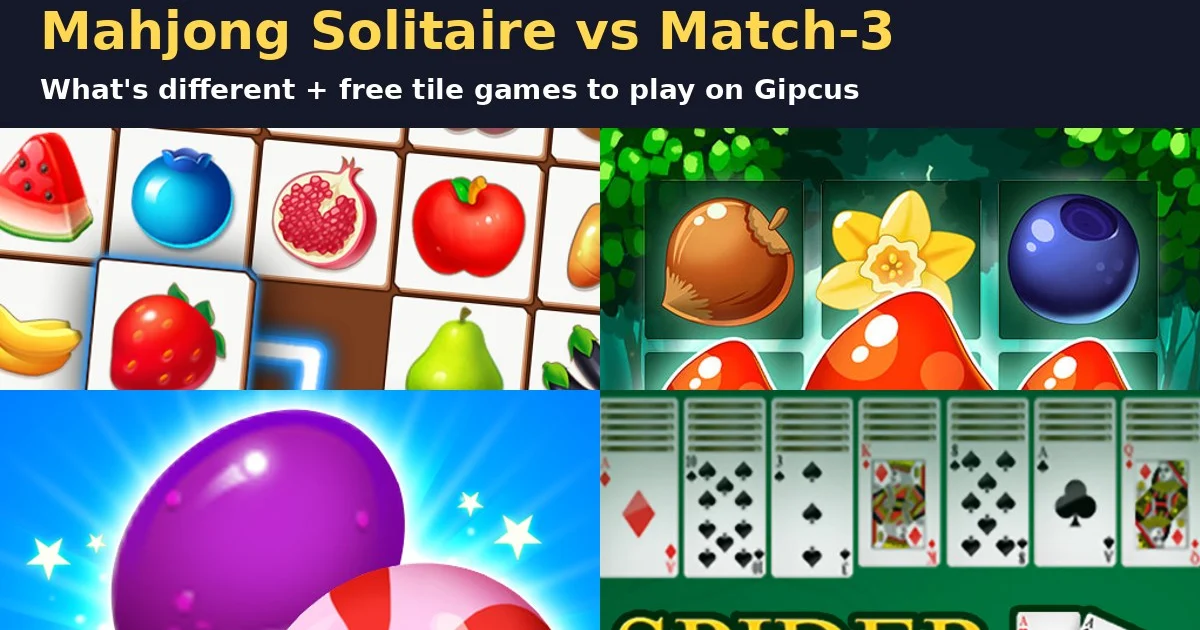
Mahjong solitaire and match-3 games both fill the screen with colourful tiles and ask you to clear them, so people mix them up all the time. They play very differently, though. One is a slow, planning-heavy pairs puzzle; the other is a fast swap-and-combo game. This guide explains mahjong solitaire vs match-3 in plain terms, and points you to the free tile games on Gipcus that scratch each itch, no download and no account.
Quick answer: in mahjong solitaire you remove matching pairs of free tiles from a fixed stacked layout, and nothing new falls in. In match-3 you swap neighbouring pieces to line up three or more, the board refills, and combos score big.
Mahjong solitaire vs match-3: the core differences
- What you match: mahjong solitaire = two identical tiles; match-3 = three or more in a row or column.
- How you move: mahjong solitaire = click two free tiles to remove them; match-3 = swap two adjacent pieces.
- The board: mahjong solitaire uses a fixed layout (often stacked layers) that only shrinks; match-3 refills from the top after every clear.
- Luck vs planning: mahjong solitaire is mostly planning, since every tile is already on the board; match-3 adds luck from new pieces and cascades.
- How you lose: mahjong solitaire ends when no free pairs are left; match-3 levels usually end when you run out of moves or time.
- Pace: mahjong solitaire is calm and quiet; match-3 is faster, with combos and special pieces.
How mahjong solitaire works (and why it is not “mahjong”)
Classic mahjong is a four-player game of sets and hands, a bit like rummy. Mahjong solitaire only borrows its tiles. You get one big layout, often the stacked “turtle” shape, and you remove two identical tiles at a time. A tile counts as free only when nothing sits on top of it and at least one long side (left or right) is open. Clear the whole layout and you win.
The skill is reading ahead. If four copies of a tile are left and you pair the wrong two, you can bury the last two under each other and lock the game. Good players clear tiles that open the most new moves first, and work on tall stacks early.
How match-3 works
Match-3 games, the Candy Crush and Bejeweled style, give you a grid of pieces. Swap two neighbours to make a line of three or more of the same kind and they pop. Pieces above fall down, new ones drop in, and if that makes another line you get a free cascade. Matching four or five usually creates a special piece that clears a row, a colour or an area.
Levels add goals like “clear the jelly” or “collect 30 berries” inside a move limit, so the planning is about setting up combos rather than solving a fixed board.
Which one should you play?
- Want a calm, thinky break with no timer pressure? Pick the pairs side (mahjong solitaire style).
- Want quick dopamine, combos and bright effects? Pick match-3.
- Want a card game with the same “plan the layout” feel? Try solitaire.
Free tile games on Gipcus to try now
Gipcus does not have a classic stacked mahjong solitaire page yet, but these play right in your browser and cover both sides of the comparison.
1. ONNECT Matching Puzzle: closest to mahjong solitaire
ONNECT Matching Puzzle is a pairs game: find two identical tiles and link them with a path that turns no more than twice. Like mahjong solitaire, the whole board is visible, nothing refills, and you win by clearing every tile. Tip: clear pairs on the edges first, since they open paths for the tiles in the middle.
2. Forest Match: a relaxed match-3
Forest Match is a woodsy match-3. Swap neighbours, line up three or more and watch the board refill. Tip: make matches near the bottom when you can, since the cascades above can chain extra clears for free.
3. Candy Fiesta: match-3 with combos and move limits
Candy Fiesta is the full Candy-Crush-style package: special candies, level goals and tight move limits. Our Candy Fiesta combo guide covers which special-candy pairs clear the most board.
4. Family Guy Match Puzzle: match-3 with a cartoon twist
Family Guy Match Puzzle gives the match-3 formula Quahog-themed pieces. Good if you want something lighter between harder levels.
5. Spider Solitaire: the planning feel, with cards
Spider Solitaire is not a tile game, but it shares mahjong solitaire’s best part: a fixed layout you solve by thinking a few moves ahead. Build descending same-suit runs to clear the tableau.
Tips that work in both genres
- Scan before you click. The first obvious match is rarely the best one.
- Open the board. In pairs games, free blocked tiles; in match-3, work low to trigger cascades.
- Save rare pieces. Don’t spend the last copies of a tile or a special piece without a plan.
- Play muted at work. Both genres play fine with no sound; see our quiet browser games for a work break.
FAQ
Is mahjong solitaire the same as match-3?
No. Mahjong solitaire removes matching pairs from a fixed layout that never refills. Match-3 swaps pieces to make lines of three or more on a board that keeps refilling.
Is mahjong solitaire luck or skill?
Mostly skill. Every tile is already placed, so careful pairing decides most games, though some deals can’t be fully cleared.
Can I play these free with no download?
Yes. Every game linked above runs in your browser on Gipcus, on phone or laptop, with no install or account.
Into other puzzle micro-genres? Read our merge games explainer (Stick Merge + 2048) or grab a quick round from the 5-minute browser games list.