
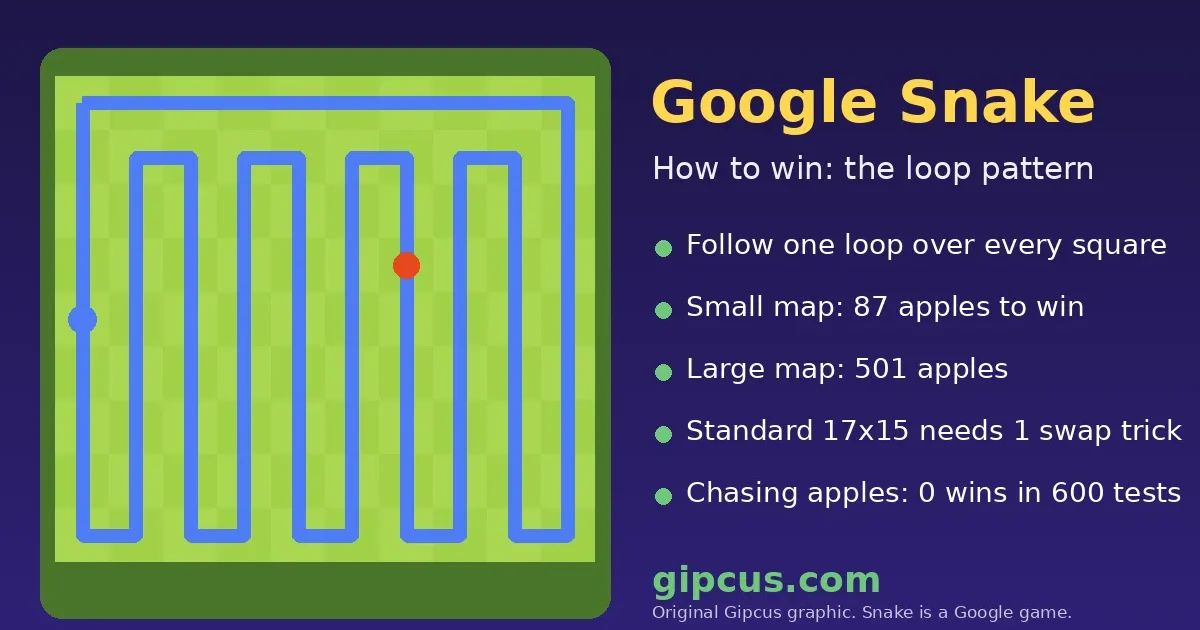
Quick answer: To win Google Snake, stop chasing apples and drive one fixed loop that passes through every square: zigzag down and up each column, then run home along the top row. Your head only enters squares your tail has already left, so you can’t crash. It wins on the Small and Large maps; Standard needs one corner switch.
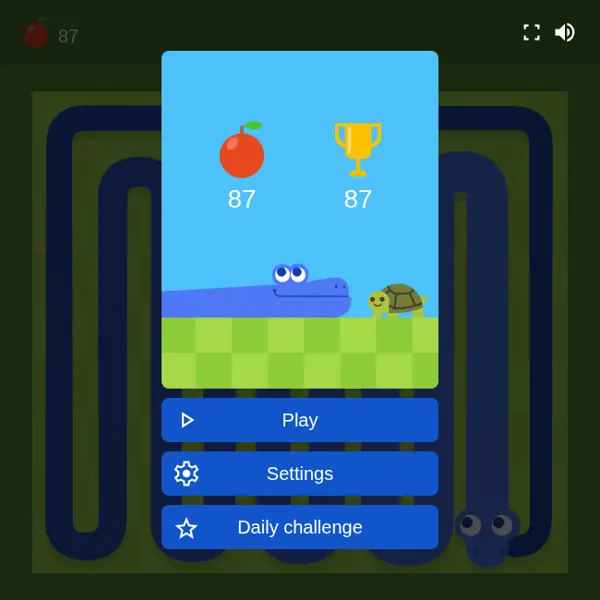
By Ashish Sharma · Updated November 1, 2026 · How we tested: we played Google Snake in Chrome at google.com/fbx?fbx=snake_arcade and drove the loop below with a script that reads the board and presses the arrow keys. It filled the Small map, 87 of 87 apples. We also counted each map’s grid in the live game, timed the speeds and simulated 670 games of two strategies on all three map sizes.
In Short
- You win by filling the board: 87 apples on Small, 252 on Standard, 501 on Large.
- A loop that visits every square once per lap can’t crash. It won all 70 of our simulated games.
- Chasing the nearest apple won 0 of 600 games and usually died before a third of the board was full.
- Standard (17 x 15) has an odd number of squares, so you loop 254 and switch a corner route when an apple lands on the spare square.
What counts as a win in Google Snake?
You win when the snake fills every square of the map. The snake starts 3 squares long and grows by one square per apple, so the winning score is the number of squares minus 3. We counted each grid in the live game and matched the totals to the Google Snake wiki’s map-size table:
| Map (Settings) | Grid | Squares | Apples to win | Perfect loop? |
|---|---|---|---|---|
| Small | 10 x 9 | 90 | 87 | Yes |
| Standard (default) | 17 x 15 | 255 | 252 | No, loop 254 and use the corner switch |
| Large | 24 x 21 | 504 | 501 | Yes |
The menu has three buttons: Play, Settings and Daily challenge. Settings sets the fruit, mode, number of apples, speed (snake icon for Normal, rabbit for Fast, turtle for Slow) and map size. Everything in this guide uses Classic mode, the trophy icon.
What is the pattern to win Google Snake?
It’s a closed loop, often called a Hamiltonian cycle, that runs through every square once and ends where it started. On the Small map, you go down the first column, then zigzag up and down the rest, stopping one square short of the top each time. You then run home along the top row. Follow these steps:
- Choose the map: Open Settings and pick the Small map (10 x 9) and Slow speed for your first win.
- Get to the top-left corner: Steer the snake into the top-left square before it gets long, while turning is still safe.
- Go down the first column: Run down column 1 to the bottom, leaving the top row for the trip home.
- Zigzag through the columns: Step right, go up column 2 but stop one square below the top, step right, go down column 3, and repeat to the last column.
- Run home along the top row: From the top of the last column, turn left and run the whole top row back to the corner.
- Repeat without shortcuts: Keep looping, even when an apple is right beside you. Each lap passes every square, so every apple gets eaten.
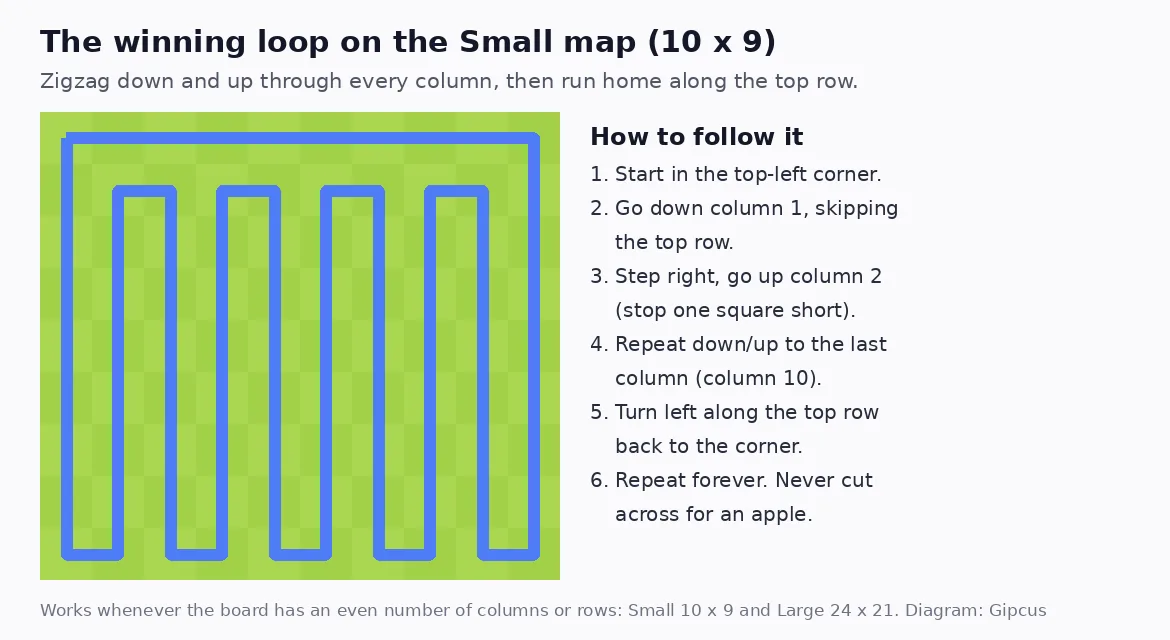
The same shape works on Large, because 24 columns is an even number: the zigzag finishes at the top of the last column, right where the home run starts. If you’d rather zigzag across rows, use whichever direction has an even count.
Why can’t the snake crash on the loop?
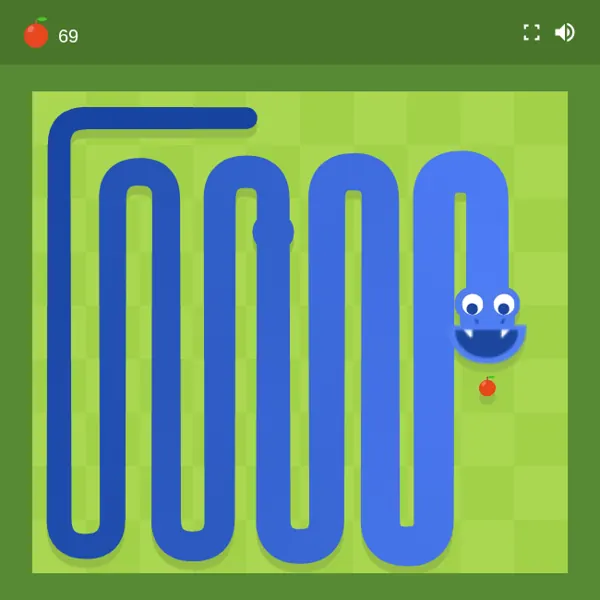
The head always moves into the square the tail left longest ago. Each lap visits all 90 Small squares in the same order. The body trails behind the head along that path, so the squares ahead of the head are always the ones the tail has already left. Apples only make the snake longer, and the snake can never be longer than the loop.
That’s why the body folds into neat columns, as in our run below. The price is time. Late in the game, the apple can be almost a full lap away.
How do you win on the Standard map (17 x 15)?
Loop 254 of the 255 squares and switch between two corner routes. Colour the board like a chessboard and every move swaps colours, so a closed loop always covers an even number of squares. With 255 squares, one square always misses out. A University of Glasgow paper on Snake’s maths shows that a 254-square loop still exists if you leave one suitable square out, such as a corner.
The catch in Google Snake is that an apple can appear on that spare corner at any time. Our fix uses two routes through the top-left corner:
- Route A: from the second square of the top row, go down one, left one, and carry on down the first column. The corner is left out.
- Route B: from the same square, go left into the corner, then down. The square you skipped in Route A now sits out instead.
- Whenever an apple sits on the square your current route skips, take the other route the next time you pass. Both routes are 254 squares long, so the loop stays safe.
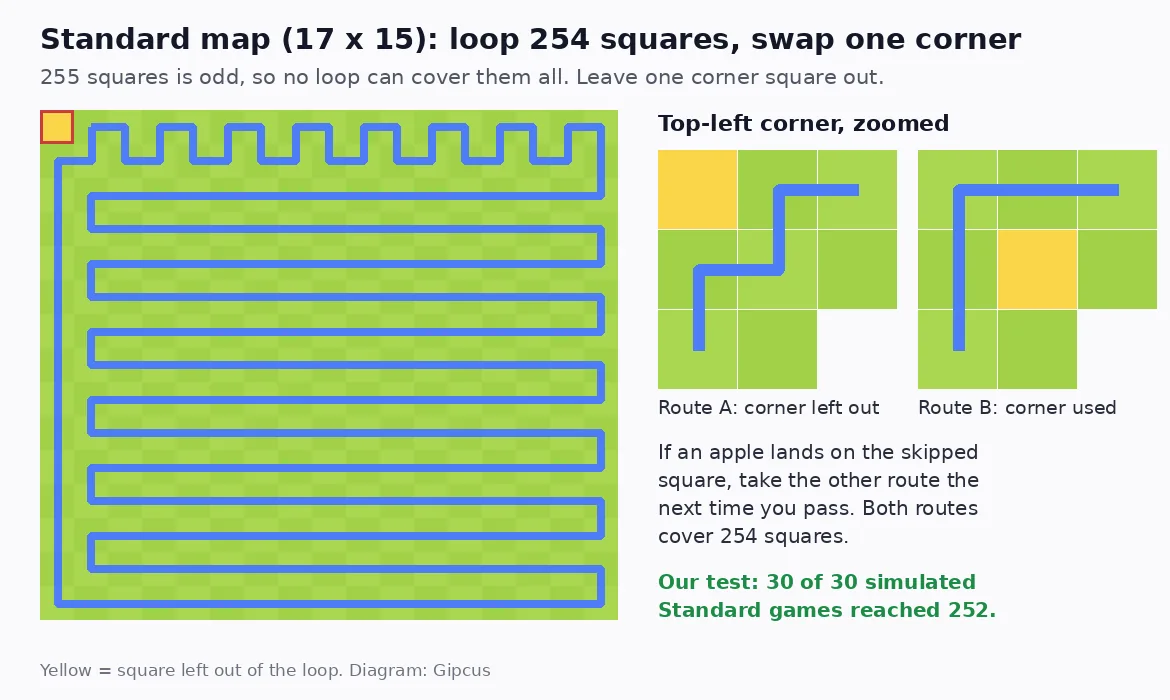
In our simulation, this switch reached 252 of 252 apples in all 30 Standard games. The final apple always lands on the spare square, and the switch is what collects it.
Is chasing the apple a bad strategy?
Yes, if you want to win. We simulated a bot that always takes the shortest safe path to the apple, which is how most people play. It never filled a board in 600 games. On Small, its median game ended at 25 apples (best 46). On Standard it ended at 50 (best 81), and on Large at 74.5 (best 129). The body cuts the board into pockets, and sooner or later the head gets trapped in one.
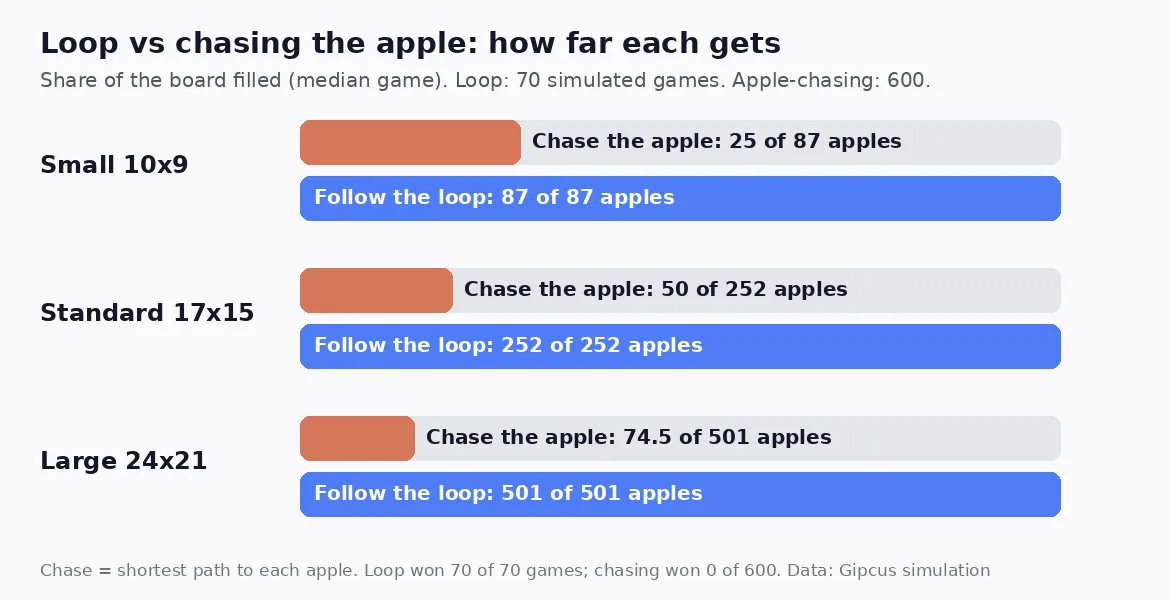
Chasing is still the fastest way to hit a quick score of 25 or 50, which is why speedrunners use it for short apple targets. For a full board, the loop is the only method that won every time in our tests.
How long does a loop win take?
About 4 minutes on Small at Normal speed, and much longer on bigger maps. We timed the snake at about 0.13 seconds per square on Normal and about 0.18 seconds on Slow. Our live Small run on Slow took 1,837 moves and 5 minutes 30 seconds.
| Map | Median moves to win (loop) | Time at Normal speed | Time at Slow speed |
|---|---|---|---|
| Small | 1,973 | about 4.5 min | about 6 min |
| Standard | 16,905 | about 39 min | about 51 min |
| Large | 63,185 | about 2 hr 20 min | about 3 hr 10 min |
Move counts are medians from our simulated games: 30 on Small, 30 on Standard and 10 on Large. Times come from our measured speeds. For a first win, use Small and Slow.
What are the Google Snake controls?
Use the arrow keys or WASD on a keyboard, and swipe on a phone. The first key you press starts the run. You can’t reverse straight back into your own neck, so a U-turn takes two presses, one square apart. On the loop, nearly every turn comes at a wall, which makes the rhythm easy to learn: two quick turns at the bottom, two at the top.
Play similar free on Gipcus
- Paper.io 2: draw loops to claim territory, and protect your trail like a snake’s tail.
- Pac-Man: the other classic grid chase. Our Pac-Man ghost patterns guide covers how the ghosts move.
- 2048: another grid game where a fixed pattern beats improvising. See our 2048 corner method.
Want more quick games? Browse our 5-minute browser games for a lunch break, our Minesweeper strategy guide and the official ways to play Geometry Dash free.
Frequently asked questions
Can you actually beat Google Snake?
Yes. When your snake fills every square, the run ends with the maximum score. We did it on the Small map with the loop in this guide: 87 apples, the most possible, after 1,837 moves on Slow speed.
What is the highest score in Google Snake?
It depends on the map. The snake starts 3 squares long, so the maximum is the number of squares minus 3: 87 on Small (10 x 9), 252 on Standard (17 x 15) and 501 on Large (24 x 21).
Why can’t I make a perfect loop on the Standard map?
Standard has 17 x 15 = 255 squares, an odd number. A closed loop on a chequered grid must alternate light and dark squares, so it always covers an even number. The best loop covers 254 and leaves one corner out, which the corner switch in this guide fixes.
How long does it take to win Google Snake with the loop?
If you follow the loop strictly at Normal speed, about 4 to 5 minutes on Small, about 39 minutes on Standard and over 2 hours on Large, based on our measured speed of about 0.13 seconds per square.
What is the easiest way to win Google Snake for the first time?
Pick the Small map and Slow speed in Settings. Small has a perfect loop and only 87 apples to collect, and Slow gives you about 0.18 seconds per square, roughly a third more time to make each turn.
Does Google Snake work with WASD?
Yes. In our test, pressing D started the snake and S turned it down, just like the arrow keys. On a phone or tablet you swipe in the direction you want to go.
Sources: Google Snake at google.com (menus, map grids, speeds and controls checked live on November 1, 2026), the Google Snake wiki for map sizes and maximum scores, J. O’Hagan, “Player Experience and the Mathematics of Snake” (University of Glasgow) for the odd-board loop proof, and Gipcus’s own scripted run and 670 simulated games.
About the author: Ashish Sharma runs Gipcus and tests every puzzle and arcade guide hands-on, from Minesweeper and 2048 to Waffle.