
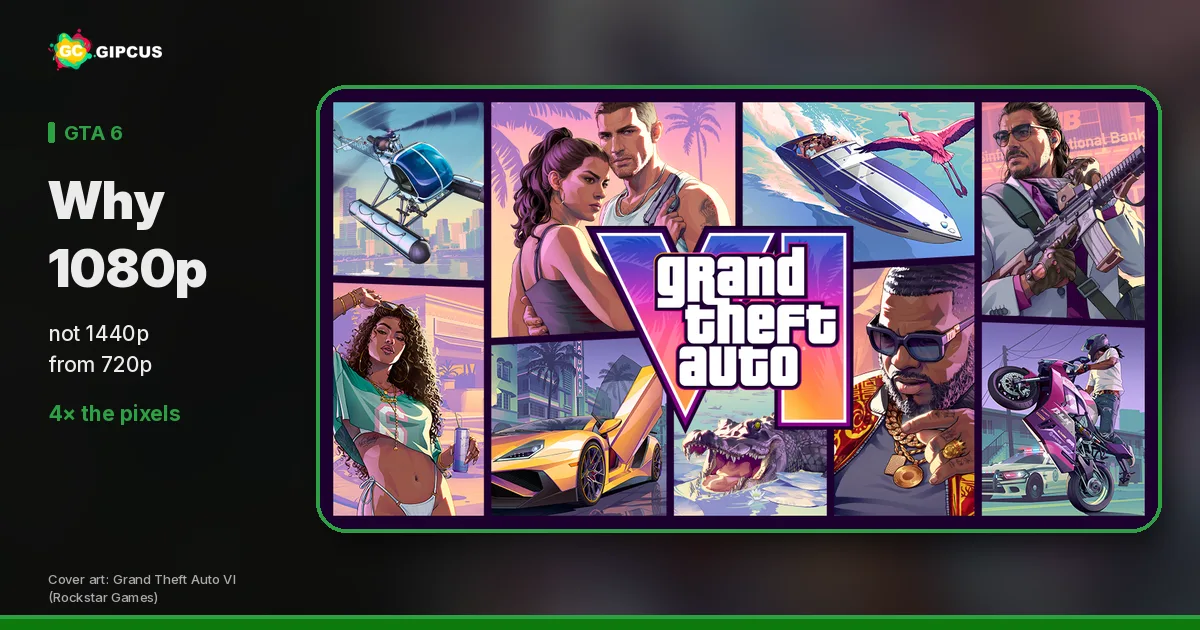
Quick answer: Xbox Series S renders GTA 6 at 720p and upscales it to 1080p with FSR 4, not 1440p. PS5, PS5 Pro and Series X render at 1440p and upscale to 4K. Rockstar kept ray-traced lighting and strand hair on the S, and Digital Foundry recorded mid-20s dips. Gipcus’s own analysis: 1440p would reconstruct four times the pixels, not 2.25 times.
Updated November 20, 2026 by Ashish Sharma.
What resolution does GTA 6 run at on each console?
Xbox Series S is the odd one out: 720p internal, upscaled to about 1080p. Rockstar told Pure Xbox that the Series S version starts at a base resolution of 720p, “which is scaled to 1080p using AMD FSR Upscaling 4.” Digital Foundry measured that output as approximately 1080p, and described FSR 4 as a temporal upscaler. IGN reported FSR 4.1.
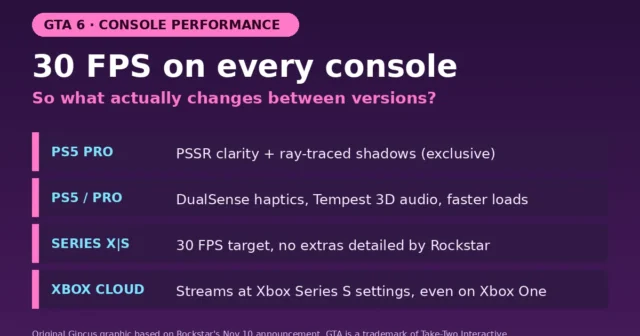
PS5, PS5 Pro and Xbox Series X all render at 2560×1440 (1440p), with no immediate signs of dynamic resolution scaling, according to Digital Foundry. The Pro upscales that image to 4K with Sony’s PSSR. Tom’s Hardware and IGN identify the Pro upscaler as PSSR 2 / PSSR 2.0. Base PS5 and Series X instead get a spatial upscale to 4K from Rockstar’s in-house TAA, which Digital Foundry says looks softer than a temporal upscaler.
| Console | Internal resolution | Upscaler | Output | 30fps target, as tested |
|---|---|---|---|---|
| Xbox Series S | 720p | AMD FSR 4 (temporal) | About 1080p, plus a 4K UI | Loosest lock: mid-to-high 20s in much of play; mid-20s in dense combat |
| Xbox Series X | 1440p | Rockstar TAA (spatial) | 4K, plus a 4K UI | Usually 30fps, often the high 20s in tougher scenes |
| PS5 | 1440p | Rockstar TAA (spatial) | 4K, plus a 4K UI | Similar to Series X |
| PS5 Pro | 1440p | PSSR | 4K, plus a 4K UI | Steadiest 30fps; short drops to 24fps in heavy explosions |
On every console, Tom’s Hardware reports, the final image is then composited with a 4K user interface before it is presented. That matters on Series S: the game world is about 1080p, but menus and HUD are still drawn at 4K. These resolution and performance figures come from Rockstar’s comments and from Digital Foundry’s post-launch tests. They sit alongside our earlier look at why every console version of GTA 6 targets 30fps.
Why didn’t Rockstar upscale Series S from 720p to 1440p?
Rockstar hasn’t explained why the upscale stops at 1080p. Asked about the upscalers, it told Wccftech, as quoted by IGN, that targeting 30fps included “determining our base resolution and upscaling solution. We evaluated a variety of approaches for each console, then selected a combination of each that gave us the look and performance we needed.”
What is confirmed is the set of trade-offs around that choice. Digital Foundry found that Series S still includes the same major visual features as Series X and PS5, including ray-traced global illumination (RTGI), ray-traced reflections and strand-based hair, with quality cutbacks. In the Pure Xbox interview, Rockstar said its “focus on lighting made it vital for us to ensure we could use the same lighting solution on each console, including the Xbox Series S, where memory pressure posed a bit of a challenge.” Digital Foundry also points to the Series S console’s “more limited memory and cut-down GPU,” while noting that its CPU and SSD are full-spec, so the scale of Leonida itself is not cut down.
The 30fps target is already under strain. Digital Foundry calls Series S the loosest lock of the four versions, with large portions of the game in the mid-to-high 20s. IGN and Pure Xbox also reported drops into the mid-20s in busier moments. On the upscaler itself, a second Digital Foundry piece cites Microsoft’s FSR 4 figures for a 1080p output: about 2.9 ms for full FSR 4 and 1.9 ms for FSR 4 Lite, out of a 33.3 ms budget at 30fps. Digital Foundry is clear that its reading of those numbers is conjecture: Rockstar has not explained the upscaler split in that level of detail.
Our analysis: a 720p-to-1440p upscale would reconstruct four times the source pixels, against 2.25 times for 1080p, and 2× per axis rather than 1.5×. That is a heavier reconstruction, which typically means more upscaling artifacts, plus a larger output buffer that would cost more time and VRAM than 1080p. Microsoft has not published an FSR 4 cost for a 720p-to-1440p path, so we are not attaching a millisecond figure to it. Given that Rockstar kept the ray-traced lighting and strand hair, and that Series S already slips below 30fps, stopping at 1080p is the more conservative fit for the frame budget.
How much more work is a 1440p upscale?
In Gipcus’s own analysis, that is four times the pixels, versus 2.25 times if the output stays at 1080p. Standard 16:9 720p is 1280×720, or 921,600 pixels. 1080p is 1920×1080, or 2,073,600 pixels. 1440p is 2560×1440, or 3,686,400 pixels. Divide those counts and 1080p is 2.25 times the 720p pixel count (1.5× on each axis). 1440p is exactly 4 times the 720p pixel count (2× on each axis).
How we tested: we multiplied the standard 16:9 pixel grids ourselves, then divided the totals. 2,073,600 ÷ 921,600 = 2.25, and 3,686,400 ÷ 921,600 = 4. The per-axis scale is 1920 ÷ 1280 = 1.5 and 2560 ÷ 1280 = 2. These are arithmetic checks of standard resolutions, not captures from the game. Digital Foundry describes the Series S output as approximately 1080p, so the live image may not be a perfect 1920×1080 grid.
Does Series S still have ray tracing and strand hair?
Yes, with visible cutbacks. Digital Foundry says all four versions use RTGI and ray-traced reflections, and that Series S also keeps strand-based hair. The reflections on Series S are softer, lower-resolution and sometimes miss details. Lighting is lower precision overall, shadow maps are lower resolution, textures can look muddier at oblique angles, and hair, volumetric clouds, water and depth of field are reduced. IGN also noticed aliasing on distant buildings and hair. Ray-traced shadows are the one extra effect reserved for PS5 Pro; the other consoles use shadow maps.
Tom’s Hardware adds that Rockstar adjusted RTGI to each platform’s hardware while trying to keep the lighting solution consistent. So the Series S version is not a stripped RT-off build. The cheaper console still carries those effects, which is one reason a higher output resolution would have been an expensive extra.
How steady is the 30fps target on Series S?
It is the loosest of the four, and there is no 40fps or 60fps mode on any console. Digital Foundry says Series S is at 30fps more often than not, but quick traversal and firefights regularly dip to the high 20s, dense combat can sit in the mid-20s, and extreme vehicle-destruction tests can reach around 20fps or the teens. Series X and base PS5 usually hold 30fps, with the high 20s in tougher scenes. PS5 Pro is the steadiest, with only short drops, to a minimum of 24fps, in heavy explosions. That is the post-launch picture behind the 30fps target we covered in our GTA 6 30fps console comparison. If a later patch changes the Series S upscaler or frame-rate, it will show up in the GTA 6 update and patch notes tracker.
What display settings work best for GTA 6 on Series S?
If your TV supports them, turn on 120Hz and variable refresh rate (VRR). Digital Foundry says Xbox can run GTA 6 in a 120Hz VRR container as an operating-system feature, “which allows for a slightly smoother experience.” That is useful on Series S, because the frame rate often sits in the mid-to-high 20s rather than a locked 30. PlayStation’s system VRR, by contrast, only operates above 48fps and does not help a 30fps title.
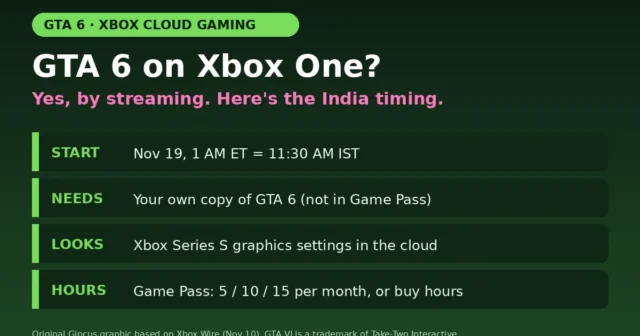
We do not have a tested “set the console to 1080p, 1440p or 4K” recommendation from the sources above, so this part is general guidance. The 3D scene is about 1080p, so a 1080p TV is a native match for the game world. A 1440p or 4K TV will scale that scene and, because the UI is composited at 4K, still show menus and HUD more sharply. Use the output your set supports natively, enable Game Mode if you have it, and switch on 120Hz and VRR when they are available. If you are streaming GTA 6 rather than running it locally, remember that Xbox Cloud Gaming uses Series S graphics settings.
More GTA 6 coverage
- GTA 6 is 30fps on every console: what PS5 Pro and Xbox really get
- GTA 6 update 1.002: size, patch notes and every update so far
- Can you play GTA 6 on Xbox One? Cloud gaming hours and limits
- GTA 6 pre-load time and 212GB file size
FAQ
Does GTA 6 on Series S run at 1440p?
No. Rockstar says the Series S version renders at 720p and is upscaled to 1080p with AMD FSR 4. 1440p is the internal resolution on PS5, PS5 Pro and Series X, which then upscale to 4K.
Why didn’t Rockstar upscale GTA 6 to 1440p on Series S?
Rockstar hasn’t explained why the upscale stops at 1080p. It said it chose a base resolution and upscaler on each console to hit the look and the 30fps target. Gipcus’s own analysis is that a 720p-to-1440p upscale would reconstruct four times the pixels, versus 2.25 times for 1080p, on a console Digital Foundry already found dipping into the mid-20s.
Does GTA 6 on Series S still have ray tracing?
Yes. Digital Foundry found ray-traced global illumination, ray-traced reflections and strand-based hair are still present on Series S, with quality cutbacks such as softer, lower-resolution reflections. Ray-traced shadows are a PS5 Pro exclusive.
What frame rate does GTA 6 hit on Series S?
All consoles target 30fps, and there is no 40fps or 60fps mode. Digital Foundry says Series S has the loosest lock, with large portions of play in the mid-to-high 20s, mid-20s in dense combat, and around 20fps or the teens in extreme vehicle-destruction tests.
Is the GTA 6 menu also 1080p on Series S?
No. Tom’s Hardware reports that on every console, including Series S, the final image is composited with a 4K user interface before it is shown.
What TV settings should I use for GTA 6 on Series S?
If your display supports them, turn on 120Hz and VRR. Digital Foundry says Xbox can run the game in a 120Hz VRR container, which smooths the picture slightly when the frame rate dips. The 3D scene is about 1080p, while the UI is 4K, so a 4K TV still helps the menus even if the game world is not a native 4K image.
Sources: Digital Foundry’s console comparison, Digital Foundry on FSR 4 costs, IGN, Tom’s Hardware and Pure Xbox. Pixel-count figures are our own calculations. See our editorial policy.
About the author: Ashish Sharma runs Gipcus and writes about game launches, live events and the free browser games on the site.