
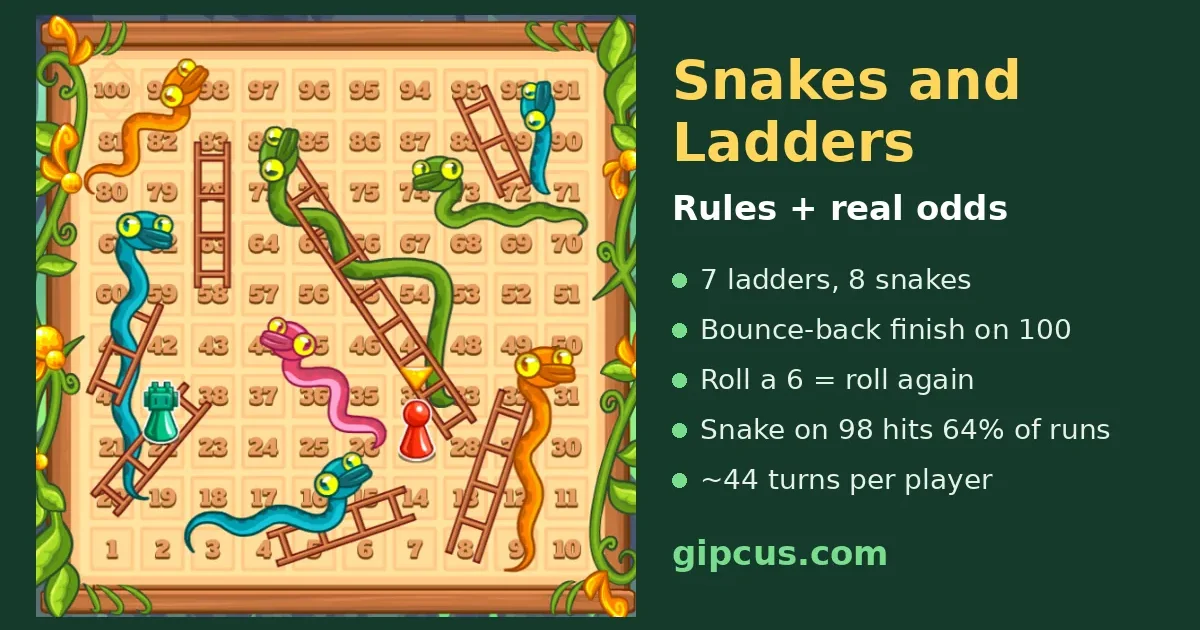
Quick answer: In Snakes and Ladders on Gipcus, you roll one die, climb any ladder you land on and slide down any snake head. A 6 gives you another roll. You must land exactly on 100, because extra pips bounce you back. Every move is forced, so luck decides the winner. A solo run takes about 44 turns.
By Ashish Sharma · Updated October 30, 2026 · How we tested: we read the code of the Snakes and Ladders build on our game page, including the board table, the dice, the extra-roll rule and the bounce at square 100. We played it in the browser to check the board against the code. Then we solved the board exactly with a Markov chain and ran 200,000 solo runs and 200,000 two-player games in Python.
What are the rules of Snakes and Ladders?
Short answer: roll, move, then climb or slide. The first token to land exactly on 100 wins.
- Both tokens start off the board. You don’t need a 6 to start, so a roll of 3 puts you on square 3.
- The game picks who goes first at random (a 50/50 spin).
- On your turn, roll the die and move that many squares. The track snakes left to right, then right to left on the next row.
- If you stop on the foot of a ladder, you climb to its top. If you stop on a snake’s head, you slide to its tail. Squares you only pass over don’t count.
- If you roll a 6, you move and then roll again. There’s no limit, so three 6s in a row still count.
- To finish, you need the exact number. If your roll goes past 100, the token walks to 100 and counts the rest back down. That square still counts, snakes included.
- The first token to land exactly on 100 wins straight away.
Each move triggers at most one snake or ladder. None of them start where another one ends, so they never chain. The code also has no capture rule. Two tokens can share a square and nobody gets sent home.
Where are the snakes and ladders on the board?
There are 7 ladders and 8 snakes. This list is copied from the game’s board table, and the board we played matched it. The “hit rate” column is how often one player lands on each square at least once in a full run, from our 200,000-run simulation.
| Type | From | To | Change | Hit at least once per run |
|---|---|---|---|---|
| Ladder | 4 | 14 | +10 | 31.6% |
| Ladder | 8 | 32 | +24 | 30.4% |
| Ladder | 20 | 38 | +18 | 35.1% |
| Ladder | 28 | 84 | +56 | 39.5% |
| Ladder | 40 | 59 | +19 | 47.8% |
| Ladder | 58 | 83 | +25 | 32.4% |
| Ladder | 72 | 93 | +21 | 44.8% |
| Snake | 15 | 3 | −12 | 30.8% |
| Snake | 31 | 9 | −22 | 29.1% |
| Snake | 44 | 26 | −18 | 40.1% |
| Snake | 62 | 19 | −43 | 31.5% |
| Snake | 74 | 70 | −4 | 32.7% |
| Snake | 85 | 33 | −52 | 52.2% |
| Snake | 91 | 71 | −20 | 42.8% |
| Snake | 98 | 80 | −18 | 63.7% |
The ladder at 28 is the best square on the board. It skips you from 28 to 84. The worst is the snake at 85, one square above where that ladder drops you. It sends you back to 33, and players hit it about once per run (1.09 times on average).
What happens if you roll past 100?
Short answer: you bounce back. From 97, a 5 takes you to 100 and back two squares to 98. Square 98 is a snake head, so you slide to 80.
This bounce-back rule, plus the snakes at 91 and 98, makes the top row the slowest part of the game. Square 98 is the most-hit snake on the board. Bouncing counts too, so it catches about 64% of runs and is hit 1.74 times per run on average. In 68% of runs a player bounces at least once. Here’s what one turn does from each square in the top row, counting extra rolls from 6s:
| You’re on | Rolls that win | Rolls that hit the 98 snake | Win this turn | Fall to 80 this turn | Turns left on average |
|---|---|---|---|---|---|
| 94 | 6 | 4 | 16.7% | 16.7% | 20.5 |
| 95 | 5 | 3 | 20.0% | 20.0% | 20.3 |
| 96 | 4 | 2 or 6 (bounce) | 16.7% | 16.7% | 22.0 |
| 97 | 3 | 1 or 5 (bounce) | 20.0% | 40.0% | 22.0 |
| 99 | 1 | 3 (bounce) | 20.0% | 20.0% | 20.3 |
Even on 99 you still need about 20 more turns on average. Square 98 itself never appears in the table, because you can’t stay on it.
Does rolling a 6 give you another turn?
Short answer: yes, for both you and the bot, every time.
The turn-change code only passes the turn when the roll is not a 6. There’s no three-6s penalty. The “extra dice” banner only shows on your own 6s against the bot, but the bot gets the same extra roll. The bonus is worth a lot. On this board, a solo run takes 43.9 turns with the 6 rule and 52.5 turns without it.
Can you win Snakes and Ladders every time?
Short answer: no. You can’t make a single choice. Every roll has one legal move, so the game is pure luck.
The bot doesn’t “play” either. It just rolls when its turn starts. Going first is worth a little: in our 200,000 two-player games, the first player won 50.6%, and the exact solution gives 50.7%. A lead is worth more than it looks, but it’s never safe:
| You (to roll) | Opponent | Your chance to win |
|---|---|---|
| 0 | 0 | 50.7% |
| 14 (after the 4 ladder) | 0 | 53.8% |
| 32 (after the 8 ladder) | 0 | 55.7% |
| 84 (after the 28 ladder) | 0 | 69.7% |
| 84 | 59 | 60.4% |
| 97 | 80 | 67.0% |
| 99 | 0 | 79.4% |
So someone sitting on 99 still loses about 1 game in 5 to an opponent who hasn’t moved yet. “Tips” for this game are really about what to expect. Don’t count a lead as won until you hit exactly 100, and don’t give up from behind.
How long does a game of Snakes and Ladders take?
Short answer: about 44 turns for one player to finish, or about 55 turns in total for a two-player game.
| Measure (this board, bounce rule, 6 = roll again) | Result |
|---|---|
| Average turns for one player to finish | 43.9 (median 35) |
| Average dice rolls for one player | 52.6 |
| Slowest 10% of solo runs | 85 turns or more |
| Fastest possible finish | 7 rolls in 4 turns (for example 4, 2, 6-6-4, 6-6) |
| Two-player game, total turns (both players) | 55.4 on average (median 47) |
The fastest route: a 4 hits the ladder to 14, a 2 reaches 16, then 6, 6 and 4 go to 22, 28 (ladder to 84) and 88. On the next turn, 6 and 6 go to 94 and then 100.
How do the house rules change the game?
Many printed sets use different end rules, so agree on them before a home game. We solved this same board under three common versions. The numbers are average turns for one player.
| End rule | With “6 = roll again” | Without it |
|---|---|---|
| Bounce back past 100 (the Gipcus game) | 43.9 | 52.5 |
| Need the exact roll, otherwise stay put | 32.9 | 39.4 |
| Any roll that reaches 100 wins | 27.7 | 32.9 |
For a quick game with young kids, use the “any roll that reaches 100 wins” rule. It cuts the game by about 37% compared with bounce-back.
What are the controls?
| Action | Desktop | Phone / tablet |
|---|---|---|
| Start | Click the Play button | Tap Play |
| Choose a mode | Pick player vs player or player vs bot, then OK | Same |
| Roll the die | Click the dice button in the bottom-right corner | Tap the dice button |
| Bot’s turn | Nothing to do. It rolls by itself. | Same |
| Settings and sound | Gear and speaker buttons, top right | Same |
There are no keyboard shortcuts. The game only saves your sound setting, so leaving mid-game starts a fresh board next time.
How do you play Snakes and Ladders with a friend online?
Pick the player-vs-player mode (the two-people icon, “Play with a friend locally”). Both of you use the same phone or computer and take turns tapping the dice. There’s no online matchmaking in this version, so for two players on two devices, sit together or share a screen. Other local two-player games are in our 2-player games guide.
Frequently asked questions
Do you need a 6 to start in Snakes and Ladders?
Not on Gipcus. Any first roll moves you onto the board. Some home rules ask for a 6 to start, but the game’s code doesn’t.
What happens when you roll a 6?
You move, then roll again. There’s no limit and no penalty for three 6s in a row. The bot gets the same extra roll.
Do you need an exact roll to win?
Yes. You have to land on exactly 100. Extra pips bounce you back, and if that lands you on the 98 snake head, you slide to 80.
Is Snakes and Ladders pure luck?
Yes. Every roll has exactly one legal move, so no decision can change the result. Going first gives a small edge: 50.7% wins for the first player in our exact solution.
What is the best ladder on the board?
The ladder from 28 to 84 (+56 squares). Landing on it with nobody else ahead raises your chance to win from about 50% to about 70%.
What is the worst snake?
The snake from 85 to 33 costs the most (52 squares). The 98 snake catches more runs (63.7%), because the bounce-back rule keeps sending tokens onto it.
How many turns does a game take?
One player needs about 44 turns on average (median 35). A two-player game lasts about 55 turns in total. The fastest possible finish is 7 rolls.
Can two tokens share the same square?
Yes. This version has no capture or bump rule, so landing on your opponent does nothing.
More board game guides
- Classic board games online free (our board-games hub)
- How to win at Ludo online (another dice race, but with real choices)
- Tic Tac Toe strategy: how to beat the bot
- How to win at UNO online
- How to play Carrom online
Play now: Snakes and Ladders on Gipcus, free in your browser with no download.