
Quick answer: To win Spider Solitaire, turn over face-down cards first, build in the same suit whenever you can, and keep empty columns for unpicking long stacks. Never deal from the stock while a useful move remains. On Gipcus there is no undo, so plan each drag. Start in 1 suit, then move up to 2 and 4 suits.
By Ashish Sharma · Updated October 26, 2026 · How we tested: we read the HTML5 code of the Spider Solitaire build on our game page (deal, move rules, scoring), played all three modes, and ran 400 deals through a rule-exact copy of the game with a simple strategy bot.
Spider Solitaire on Gipcus: key facts
It is classic two-deck Spider: 104 cards, 10 columns, 8 King-to-Ace runs to win. The scoring system, the missing undo and the drag-only controls are worth knowing before you start.
| Feature | What the game actually does |
|---|---|
| Cards | 104 (two decks’ worth) |
| Modes | Easy = 1 suit (all spades), Medium = 2 suits (spades and hearts), Hard = 4 suits |
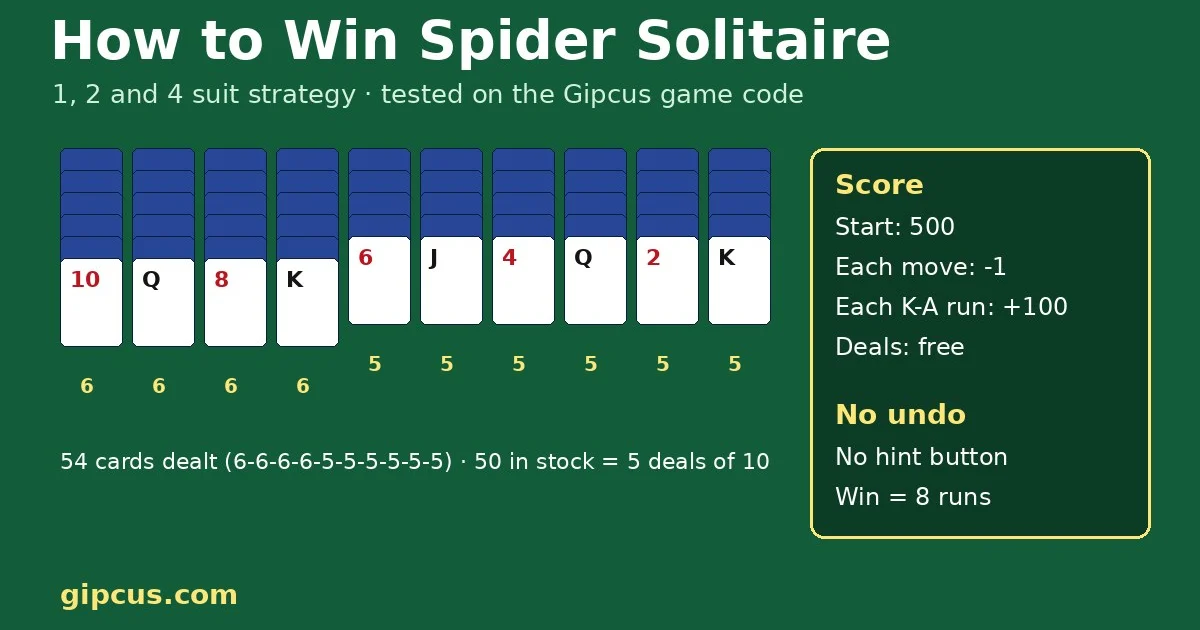
| Starting deal | 54 cards in 10 columns: 6 cards in the first 4 columns, 5 in the other 6. Only the top card of each column is face up. |
| Stock | 50 cards = 5 deals of 10, one card onto every column |
| Dealing rule | You can’t deal while any column is empty. Clicking the stock then flashes a reminder that every column needs at least one card. |
| What you can move | One card, or a run of cards that are all the same suit and go down in order (for example 9♠ 8♠ 7♠) |
| Where it can go | Onto any card exactly one rank higher (any suit), or into an empty column (any card) |
| Completed run | King to Ace of one suit is removed by itself and flies to the foundation area |
| Score | Starts at 500. Each move costs 1 point (it never drops below 0). Each completed run gives +100. Dealing from the stock is free. |
| Undo / hint | No undo and no hint button. The only “hint” is the empty-column warning above. |
| Winning | Clear all 8 runs to get the “You win” screen with your score. There is no lose screen. If you get stuck, press Restart for a new shuffle. |
What are the controls?
Everything is drag and drop, with the mouse or a finger. Clicking a card does not auto-move it.
| Action | Desktop | Phone / tablet |
|---|---|---|
| Move a card or run | Click and drag the top card of the run you want | Touch and drag |
| Drop on a column | Release over the target column | Lift your finger over the target |
| Deal 10 new cards | Click the stock pile (bottom right) | Tap the stock pile |
| New game | Restart button | Restart button |
| Rules and scoring | Help button | Help button |
Drop tip: the game puts your cards on whichever column they overlap most when you let go. If two columns are close together, centre the card over the one you want. A drop that misses, or lands on a card that doesn’t fit, sends the cards back with no point lost.
How do you play Spider Solitaire?
- Pick a mode. Easy (1 suit) if you are new, Medium (2 suits) when you win Easy most of the time, Hard (4 suits) for the real challenge.
- Read the board. Look at all 10 face-up cards before moving. Find moves that will turn over a face-down card.
- Build down. Drag a card onto a card one rank higher: a 7 onto an 8, a Queen onto a King. Any suit is allowed, but same suit is much better (see below).
- Move runs together. A same-suit run in order, such as J♥ 10♥ 9♥, can be dragged in one go by grabbing its top card.
- Use empty columns. Any card or run can go into an empty column.
- Deal when you are stuck. Click the stock to put one new card on each column. Fill any empty column first, because the game won’t deal with a gap.
- Finish runs. When a column ends with King down to Ace of one suit, the run is removed. Remove all 8 to win.
How do you win Spider Solitaire? 8 strategy rules
The short version: reveal hidden cards, keep runs in one suit, treat empty columns as gold, and only deal when nothing useful is left.
- Turn over face-down cards first. Each hidden card you reveal gives you new options. If two moves look equal, pick the one that flips a card. A column with no hidden cards left can be emptied.
- Build in the same suit whenever possible. 8♠ onto 9♠ can be moved again later as a run. 8♠ onto 9♥ cannot, because a mixed run is stuck until you take it apart card by card. In 2- and 4-suit games this matters more than anything else.
- Don’t break a same-suit run to make a mixed one. Lifting 7♠ off 8♠ to put it on 8♥ undoes your work. Only do it if it flips a card or empties a column.
- Empty a column, then use it as a workspace. One free column lets you split a mixed stack and rebuild it in suit. Don’t park a lone low card there just because you can.
- Kings are hard to move. A King can only go into an empty column. Don’t empty a column just to bury it under a King unless the King’s column hides cards you need.
- Use up every useful move before you deal. A deal drops a new card on every column, which can cover runs you were about to finish. Dealing doesn’t cost points, but it does cost options.
- Before a deal, tidy up. Put mixed cards where a covering card hurts least, and fill empty columns with the card you need least, since the game insists on it.
- Think before every drag. With no undo, a move can’t be taken back. Count what a move reveals or blocks before you let go.
Does building in suit really matter? Our test
Yes, a lot. In our 2-suit test, the bot won 4% of games when it preferred same-suit builds and 0% when it ignored suits. It won 74% of 1-suit games and none in 4 suits.
We copied the game’s rules into a script: the same deal, the same “same-suit runs only” move rule, auto-removed runs and the empty-column deal rule. Then we let a simple bot play 80 deals per setting. The bot scores each position by hidden cards, empty columns and same-suit links, and looks a few moves ahead. A strong human will beat it, especially in 2 and 4 suits, so read the numbers as a comparison between strategies, not as the best possible win rate.
| Mode | Bot strategy | Deals | Wins | Median moves in a win |
|---|---|---|---|---|
| 1 suit | Reveal cards + empty columns + same-suit links | 80 | 74% | 340 |
| 1 suit | Same, but no bonus for empty columns | 80 | 81% | 206 |
| 2 suits | Reveal cards + empty columns + same-suit links | 80 | 4% | 277 |
| 2 suits | Same, but ignores suits | 80 | 0% | – |
| 4 suits | Reveal cards + empty columns + same-suit links | 80 | 0% | – |
What this shows:
- Easy is very winnable. Even a basic bot cleared about 3 out of 4 one-suit deals.
- The jump from 1 to 2 suits is huge. The same bot went from 74% to 4%. Mixed-suit stacks can’t be moved as a unit, so most of the game is about avoiding them.
- Suit discipline separates wins from losses. Once the bot stopped caring about suits, it never won a 2-suit game.
- Emptying columns too eagerly can cost you in 1 suit. Without the empty-column bonus, the bot won slightly more often (81% vs 74%; with 80 deals that gap is within normal luck) and used far fewer moves. In 1 suit every run can be moved anyway, so empty columns matter less than in 2 or 4 suits.
How does scoring work, and how do you get a high score?
You start with 500, lose 1 per move and gain 100 per completed run. If your score never hits zero, a win scores 1,300 minus your number of moves.
| Moves used to win | Final score |
|---|---|
| 150 | 1,150 |
| 200 | 1,100 |
| 340 (our bot’s 1-suit median) | 960 |
| 500 | 800 |
- Only moves that land count. Missed drops and deals are free.
- Don’t shuffle cards back and forth between two columns. Each trip costs 1 point.
- In Easy, a fast win of 150 to 250 moves is realistic. In Hard, just winning is the achievement.
1 suit vs 2 suits vs 4 suits: which should you play?
| Mode | Suits used | Difficulty | Best for |
|---|---|---|---|
| Easy | Spades only (8 sets) | Most deals can be won | Learning, short relaxing games |
| Medium | Spades and hearts (4 sets each) | Hard: suit planning starts to matter | Players who win Easy often |
| Hard | All 4 suits (2 sets each) | Very hard, especially with no undo | Experienced players |
Common mistakes to avoid
- Dealing as soon as the first obvious moves are gone.
- Putting a card on the wrong suit when a same-suit target is also open.
- Filling an empty column with a King or a lone low card for no reason.
- Making moves that reveal nothing and only cost points.
- Dropping between two columns so the card lands on the wrong one.
FAQ
Is Spider Solitaire free on Gipcus?
Yes. It runs in your browser on desktop and mobile with no download or sign-up.
Is there an undo button?
No. This version has no undo and no hint button, so each move is final. Plan before you drag.
Why can’t I deal new cards?
One of your columns is empty. The game deals one card to every column, so every column needs at least one card first. Move any card into the gap, then click the stock.
Why can’t I pick up a group of cards?
You can only move a group if all the cards are the same suit and in order. A mixed group like 8♠ 7♥ has to be moved one card at a time.
Can you move a King into an empty column?
Yes. Any card or same-suit run can go into an empty column. It’s the only place a King can go.
How many deals does the stock have?
Five. The stock holds 50 cards and each deal puts 10 on the board, one per column.
Is every Spider Solitaire game winnable?
No. This version shuffles at random and doesn’t check whether the deal can be won. Most 1-suit deals can be won. 4-suit deals are far harder, and some can’t be won with any order of moves.
What happens when I get stuck?
There is no game-over screen. Press Restart for a fresh shuffle in the same mode, or exit to pick a different mode.
More quiet puzzle games and guides
- Play Spider Solitaire free
- Quiet browser games for a work break (our hub for calm, no-sound games)
- Mahjong Titans tips: how to win the Turtle
- How to play Minesweeper online
- 5-minute browser games for a lunch break
Rules background: Spider (solitaire) on Wikipedia.